Wednesday, 28 July 2010

Belgrade and the Centar.

Oh well... I am slacking again. I don’t even know why. Maybe it’s the fact that I’ve left it for so long and my memory is rusting up and I cannot remember what happened next. Or it could be my willpower. I don’t know... but I’m getting there. Even if it is at a snail’s pace... and the snail has a bad foot... and has asthma... and lost... and getting on a bit... and also lazy...

But anyway... Belgrade. That’s where I left off!

So, two nights in Hostel Centar, situated on a busy main road going into the city centre. And the room? Well, it was a dorm (with internet access!) on the third floor of an old-looking building. We got there before everyone else arrived, and found these two beds (basically, they were only the mattresses) shoved on this balcony thing above the room, accessible by a ladder. It was a cosy place to stay; it was above the windows and in the ceiling area, where it was sloped due to the roof being there. During the night was warm, though... it was probably the position of the mattress beds, and when the morning came with the Sun beating down on the roof, it was surely becoming an oven!

But anyway, we weren’t going to stay there all day. We got a city to see. And getting there by foot wasn’t too bad. It took a good few minutes, but it was easy enough. We got to the Sava River, just before it joins the mighty Danube, and there, berthed on the banks, were the most rustic and poor conditioned boats I have ever seen. To be honest, I don’t know what they were. They were boats, but didn’t look as if they were. They were more like old buildings or abandoned warehouses that floated alongside the riverbank.

We made our way towards the fortress on top of the hill. The fortress, Kalemegdan, whose site has been occupied over thousands of years, stood on the hill overlooking the confluence of the two rivers running through Belgrade and overlooking to two main areas of the city, New Belgrade on the opposite side of the River Sava, where the banks and high-rise offices are based, and Old Belgrade, where the cultural and historical parts of the city lay.

The fortress was in between these areas, so all walks of life could be found passing through the fortress and the park within its walls. There are people sunbathing on the lower walls of the fortress, old men playing chess in the shade of the trees and kids asking people like us for a couple of Serbian Dinars to buy some ice cream and people on stalls selling Serbian stuff and Serbian fruit wine, which I still have a bottle of!

After a few hours wondering around the city centre, passing old concrete buildings with signs in Cyrillic, and old car with a Christmas greeting on the bonnet and lots of battered and rusty trolleybuses, we headed back to the hostel to change and ask the guy at reception about somewhere to eat. He suggested the ‘Mark of Question’. We were a bit confused about this, but when we got there, this place actually had no real name, but the place was actually called ?. But it looked nice enough... it was busy, too. The menu was also interesting. After asking the waiter what this dish was, he said it was basically bull testicles. Unfortunately, it wasn’t available that night, so I settled for simple goulash. Still good, though! But I couldn’t tell anybody that my food was a load of bollocks...

But soon after the food and a couple of glasses of local beer, we headed back. It was going to be a long day to Budapest the next day.

Tuesday, 22 June 2010

Remember, remember... what happened on that day again?

June 2009? Pfft... it’s been a while, and where has the time gone? Well, if there are any readers anymore, I would like to apologise to you. Just been a bit busy in the past year and that was mostly uni. But now that’s finally over and done with, I can get back onto updating this dusty, forgotten crevice of the web!

But, before I go on to what I am up to these days, I thought I’d enlighten the uneducated on how the trip around Eastern Europe went, and I shall try to remember the events that unfolded! I think a consultation with last year’s humble diary is in order... and I’ll put on some Beethoven to get in the writing mood!

Let’s see... the last time I posted was about entering Serbia and making our way to Belgrade. It was Day 7 (still), and after the bureaucratic bother at the border, we could finally make good progress to the capital city of Serbia and also what used to be Yugoslavia.

The countryside of western Serbia was very much like that in Srpska: mountainous, sparsely populated and bad roads, though very much picturesque, and naturally I stopped a few times to take a few photographs.


And has anyone heard of a hitchhiker who doesn’t want to get picked up? Well, we found one about ten miles outside Belgrade. For a couple of miles, there was a car behind us, despite it being clapped out, rusty and just plain old, it was being driven a bit erratically and sometimes got a bit too close for comfort behind us. Anyway, as I was coming up to a garage on the opposite side of this wide road, I thought I’d call in for a bit. I pulled over onto the side of the road to wait for traffic to clear and suddenly, the frantic driver behind me skidded to a halt in front of me. The words ‘hijack’ and ‘Serbian Mafia’ came to mind. A passenger got out, walked towards my car and stopped. He just stood there as if he were waiting for something. Anyway, the old car drove off and I crossed the road to park in the garage opposite.

Soon we realised that he was waiting for a lift, and after some consideration, we decided to ask him where he was going and whether he wanted a lift into Belgrade. With his poor English, he went “no, thanks you. No speak English, I want Serbia speak.”

Fair enough, then. I think it’s one of few hitchhikers who had ever refused a lift, though I can understand the reasons being the language barrier. And maybe he wanted to take in the dusty, roadside environment for a bit longer.

And so, finally we arrived in the Serbian capital after a somewhat interesting drive, with crazy truck drivers who thought it normal and safe to overtake slower (or so they underestimated) vehicles, which were often in a similar or better physical condition, when going around bends, and in the countryside of Serbia, there are many narrow and bendy roads traversing along the sides of the winding valleys.

Hostel Centar will be the new home for the next two nights...

Tuesday, 2 June 2009

A Day At The Office

Day 7, Part II
Višegrad, Bosnia and Herzegovina – Priboj, Serbia


Višegrad seemed like a typical post-Communist town. It was in the middle of nowhere, basically. Its river had a hydroelectric dam upstream and the buildings were decaying and architecturally bland with a hint of greyness and concrete. The cars and vehicles were old and dirty, spewing out black fumes from rusty exhausts.

We looked for somewhere that would know about the price of a Green Card into Serbia, and asked in a bank, which was a small room with a metallic desk and bullet-proof glass, who wrote something down in a piece of paper and told us to go there. Presumably it was some kind of office, such as an insurance company. However, we couldn’t really find it, even though the directions were simple: follow the street to the end until we reach a square.

At the square, there was no sign of this place, and then we went into another bank. It was not as dark as the other one, and it didn’t look like some kind of interrogation cell, either. We waited in a queue behind an old woman and a young farmer wearing a faded red baseball cap and denim dungarees, who reminded me of someone from something out of ‘The Deliverance’. We showed the banker this piece of paper and led us outside to show us where it was, but she wasn’t sure herself. Then she called out Billy the Kid and asked him. As he knew where it was, he told us to follow him. I just hoped he wasn’t going to whip out his banjo and tell us to be pigs…

But no, he didn’t. Instead, we went to this office, but as it was empty, we went across the square into this pub, where the guy who ran the office was there drinking and smoking as if it was his day off. Back in the office, there were a few certificates on the wall, a computer on a desk and on the small table in the corner; there were empty whisky glasses and a few cigarette butts in the ashtray. Typical of Eastern Europe. He then took out a cigarette, slowly lit it and began explaining where to go by pointing at the map and how much it was going to cost for a Green Card. His English was very limited and was unable to string a sentence together, and he decided to shout across the square to someone else in the pub.

This second guy began staggering across the road and into the office. It turns out that he spoke German and could tell us more easily about it by the first guy talking in Serbian (or Bosnian or whatever) to the second guy, who then told us in German. It was really confusing, as we tried to ask about things, then going through him to the other guy and then back to us. Eventually, we got things sorted. We had to go off the main road, which wasn’t very main, and then go onto a small country road that took us south through the hills and countryside to a place called Uvaz (or Увац, pronounced ‘oo-vats’). It is a small place, and there it should be cheaper, roughly around twenty Euros worth.

After saying goodbye to the two drunken guys at the office/pub, we headed back to the car and left what was a very amusing and unforgettable encounter. And that’s what I like about travelling amongst other things; meeting random people in random places and trying to communicate with each other through very different languages, and also gaining a much better and detailed map of Serbia and Bosnia & Herzegovina.

Leaving the country to get into Serbia, however, proved another difficult task to get through. We got to the border control, which was in this small village in the middle of nowhere. I parked outside the controls, which were just two small portable cabins with plastic deckchairs outside, occupied by border guards who were either smoking, reading newspapers or playing cards.

I went to ask one of them where I could get money from a bank to pay for the Green Card. He said it would cost about a hundred Euros, not twenty. He said that there isn’t anywhere that would make it cheaper, and the only bank in the area was the one in the village, which closes for the afternoon. To get to an open bank, we would have to drive all the way back into Višegrad, which wasn’t really worth the effort. He also said there was a bank in a town over the border, but it would take about ten minutes by car or two hours by foot.

After confirming this with the Serbian border control over the bridge, I decided we would have to get the Green Card there, but we had to leave the car between the borders until we could get the right documents. And so, we left Bosnia, got an exit stamp on the passports, which looked just like the entry stamp but in blue. The stamps were quite boring, anyway. We expected some kind of different design or layout than the others, but they were very similar to the EU stamps, but with the letters in Cyrillic.

We left the car just before the gates into Serbia, and went to talk to the guard there. She said she would have to phone the insurance woman, who would have to drive to the border, pick us up, then take us into Priboj, which was a five minute drive, then take money out of the bank, then drive back to the border and sort the Green Card out and then be on our way. But the cost was going to be a hundred Euros, plus some money for the woman who was to take us. I had that feeling it was going to be fun!

We waited for the woman to arrive and sat in the car until she did so, and as we waited, we listened to some of the Ricky Gervais Show and played Monopoly on Rob’s phone for at least an hour. We tried to figure out what car she’d drive and whether it would stop at the car park on the other side of the barriers. We wondered what type of car, too. In Bosnia, the cars were old, rusty, cheap, incomplete, damaged, smoky and were just unfit for proper roads. We doubted that the nicer and better cars would be a popular sight, and if they were around, they were probably driven by government officials, banker managers, successful businessmen and some people who make their money in dubious ways.

And then she arrived. We didn’t see what she drove, but we saw this blonde woman walking towards the barriers, crossing the street and out of view. We had no idea why she did this because all that was on that side of the road was wasteland and some railway and the border offices were on the other side of the road. Then the guards called us over.

They explained that we had to go in her car, go to Priboj, get the money, come back to the border and pay for the Green Card, then go. So nothing we didn’t know already. And then off we went. Her car was a white Volkswagen Golf, of the second mark. It had all the tell tale signs that it was being driven in a developing country. Rust, stiff door handles, unclean inside and out, with tapes strewn everywhere as well as tissues, old crisp packets and other wrapping, empty beer cans (I just hoped that they’d been there at least since the day before). The seats were really dusty and not in their original black colour. The tape deck was missing a tape player, and the rev gauge behind the steering wheel was missing the needle and half of itself. I couldn’t tell if the speedometer was working properly, though. And so we just sat in the car for about ten minutes to Priboj, and making a conversation was a lost cause, with us unable to speak Serbian and her not speaking English nor German. It felt kind of awkward.

On the way to Priboj, we passed what seemed more primitive than Višegrad. The first thing that caught my eye was this huge plain and ugly building on the side of the road. It looked very similar to all the other large buildings we have come across so far. I assumed it was a disused power station or something. The windows were either boarded up or smashed and the walls were cracked and dirty. There was no sign of life at the place, apart from weeds and plants sprouting out of the concrete.

There was nothing much spectacular in Priboj, either. It seemed busy, but what was there, I don’t know. We didn’t really go far into the place, as we headed straight back after getting the wad of worthless notes out. And after signing the forms and relevant documents for the Green Card, we got out passport stamped (which looked just like the Bosnian, but smaller), we finally were on our way into Serbia, again.

Добродошли у Републку Српску

Day 7, Part I
Sarajevo, Bosnia and Herzegovina – Višegrad, Bosnia and Herzegovina

As we got to Sarajevo rather late, we thought we’d have a quick look around the place before setting off to Serbia. The city is rather small, and could easily be seen in an hour or so. The smell of cooking ćevapi was still in the air and the crowds of people were larger, and so were the groups of pigeons.

I was half tempted to buy a fez, as they were on sale in the many shops that surrounded the square along with the cafés. In the end I didn’t, but I did see a fez on the head of this old man sitting in front of the gates of a mosque as he was smoking a rolled cigarette and possibly preaching his wise words to the passing public.

Back at the hotel, we tried to find out about Serbia, the Green Card and the tolls for the motorways there. The receptionist didn’t know, but a Polish guy, dressed rather smartly in a suit, recognised our accents and asked if it was our car outside with the Welsh sticker on the back. Indeed it was mine, and he went on about when he lived in Porthcawl for some time and we were all talking about Swansea, Trecco Bay and other random stuff about home.

We also asked him about the tolls of the motorway in Serbia. We heard that it would cost us an equivalent of 85 Euros, to which he replied was crap… of the bull kind. He said it was much cheaper, but not sure by how much, though it certainly didn’t add up to such an amount. Though he agreed that the Green Card for Serbia was significantly worse for the wallet, in places it can add up to around a hundred Euros, but in some places, especially the more isolated and smaller border stations, it can be for much less. He also told us of someone he knew had an ‘under the table’ deal with the border guards, which cost him just twenty Euros. So even the border guards think it’s a rip-off.

And so off we went and out of Sarajevo. Leaving the noise and smells and bustle of a city and entering valleys of farmland and forests with bad roads. Later on, we passed a couple of police officers or soldiers with small automatic rifles. We weren’t sure what they were there for or why they were armed like that until we went under a small tunnel and around the corner saw a large sign, both in Roman and Cyrillic alphabets, welcoming us to the Srpska Republika.

From this point onwards, things began to change in this Serb region. The roads became worse, the road signs were all in Cyrillic and the fuel prices were all the same in every garage. It really did feel as if we were in Eastern Europe, luckily, I could read what the signs, otherwise we may well have been stuck. But the landscape was still scarce of human life. There were few houses, and the villages we passed were more like hamlets and there wasn’t much traffic on the roads apart from the few small tractor like carts struggling the ascent of the many steep roads.

As we got closer to the border, we weren’t sure where the best place to go was. We didn’t have any decent maps of the area, as the government may be a bit sceptical about allowing images and mapping being loaded on the Internet. So we stopped in this seemingly isolated town called Višegrad.

Tuesday, 12 May 2009

A crash course in bridge diving and raki.

Day 6, Part II
Mostar, Bosnia and Herzegovina – Sarajevo, Bosnia and Herzegovina

Arriving at Mostar wasn’t too difficult, following signs for it with the Roman alphabet spray painted off helped to improve my Cyrillic reading skills, which I haven’t done so since I stopped learning Russian a couple of years, even though the Balkans added a couple of alterations and letters.

Parking at Mostar was easy enough, too. I found a decently sized space on the side of the road, which was right next to a set of steps leading into the pedestrian zone. After seeing some of the Bosnian driving, I made sure there was nobody behind me before reversing into the spot, God knows what the driver behind would have done otherwise. But I think the pavement was wide enough.

Considering being a relatively narrow road and part of the one-way system, the street was busy, bustling with people crossing the road everywhere and whenever they felt like; the sounds of horns blaring from every vehicle, even the motionless ones; and the chugging sounds from the worn out engines of the worn out cars.

Walking down the steps into the centre, passing a Labrador sitting on the pillar of the wall as if he was guarding it, we got into the centre, which was busy with people from many different nationalities. The narrow and cobbled streets were lined with small shops selling keyrings, old Yugoslavian currency, handmade wooden chess sets and clothes.

The original Stari Most was built in the sixteenth century, by using a new feat of engineering design. It served the people of Mostar and the growth of the city, connecting the two sides of the Neretva River. It became the most important emblem of the city. But in 1993, the Bosnian-Croat artillery reduced it to rubble on the riverbed. This deliberate act finally got the attention of the UN and the Western nations to intervene in the war, in order to get it over and done with as soon as possible.

With the war finally over, and the city slowly rebuilding itself to how it once was a prosperous and lively place, the rebuilding of the bridge began. It was built to how it once was, using the rubble salvaged from the river, and now serving as a diving board into the river, despite the river being shallow and the bridge somewhat high.

As a reminder of what happened to Mostar, the people, the bridge and also the nation, there is a block of stone, presumably from the original bridge, on each side of the river, with the words painted in thick, black lettering: Don’t Forget ’93.

After wandering around this old and fragile looking city, we followed the river upstream through the valley towards Sarajevo. As Rob munched on a very good and very cheap kebab, I drove the car up one of the most spectacular valleys I’ve seen.

The river cuts through the mountains, forming a steep valley, flanked by dense, green forests. Both the road and the railway run along the steep mountainside, through many tunnels and over several bridges, sometimes we were driving on a platform, built hanging over the riverbanks. All that we saw were high mountains, forests, the blue river and old, aged hydroelectric dams and power stations. However, as the river and valley was not very straight at all, neither were the roads, making it difficult to get passed some of the many lorries and slow vehicles that frequent this route.

It was like this for most of the way to the capital. But we knew once we got there. The roads became better, but busier and wider. Those tall, old, grey concrete building started to pop up from the ground. The noise became louder and louder; an orchestra of horns, rattling trams and crazy drivers screeching their tyres as they swerve from lane to lane in any random order, in the mindset that their car or van or truck has its own force field, being unable to come into any contact with vehicle or pedestrian, no matter how it’s driven.

Finding the hostel wasn’t too straightforward, either. Quite literally. We had to run alongside the river, bypassing the centre of town until we got to a junction of some kind. It was unclear what this junction looked like, as it was right at the edge of the map. But we could work out that it bent left, nearly double backing on itself. And we believed we came to such a junction, as it seemed there was no way to continue apart from trams. So we went left, following the road around, straight into the centre of town itself.

Road and safety awareness goes straight out of the window at this point. There are crowds of people congregating in the middle of this junction, as trams, taxis and cars try to make their way through. And the way we needed was right in the middle of it. I had to get the car through this crowd and up the hill, but slowly I made it. Then we took a couple of back streets (which were just normal Sarajevan streets, apparently). We got to a small fork junction, one straight ahead, but blocked by a parked car, and one up a steep hill with a no entry sign. So I had to choice but to make it up that hill, after all, it was short and everyone does what they well like, anyway!

Finally at the top, after abusing my clutch and creating that lovely burnt smell that it does, we went further along the maze until we reached the hostel. It looked like a hotel, in fact. It was one of those places that could be described as both. And blending in with other residents of Sarajevo, I parked wherever I could, which happened to be right in front of the hotel, but conveniently making enough room for anyone to pass, if they were able to actually make further progress.

Inside the hostel or hotel, it looked very modern and presentable and clean. The room, however, was on the top floor and only had one bed, though it was a double and big enough for two. The room itself wasn’t as friendly for tall people, as I often hit my head on the low ceiling, especially the parts where it sloped. The view, however, was great. We could see the whole city; the red rooftops, including ours; the tall minaret that stood gracefully right beside the hostel; the green, sloping mountains; and the valley leading up to them that was once dubbed as ‘Sniper Alley’ during the war.


We left the hostel and went into the centre. By now, it was getting dark and the place started to quieten, as if there was some kind of curfew left from the war. We looked around for a place that made kebabs. The whole town smelled of kebabs. Not the kind of kebabs you find in greasy places at three in the morning when you stumble in, drunk up to your eyeballs after a heavy night out back home. These places cooked fresh and proper meat, cooked with good herbs and spices, and served in freshly baked bread. They were really good, yet so cheap.

We found this outside bar showing some football match between some two teams, but all I was interested in was the beer. Later on, we started talking to this group of Americans, who were serving in the army in Germany. We moved on from talking about football, or soccer, and went on to talk about Sarajevo, Bosnia and the situation it was in just less than two decades ago.

We parted ways and later we found a bar, which had a more Turkish oriented feel to it. We had some more kebab type stuff there, and Rob suggested we got a raki, which was a herb based spirit drink, like tequila or grappa, but much to my distaste. Not only was it strong, but also I just couldn’t get round the taste of it. So Rob finished it off for me. In the meantime, we were talking to the barman about where he was from (Turkey), where Rob went to in Turkey, and also more conversation about how the country is developing after independence and war and all the troubles in the past years.

And after a long time conversing about these things, it was time to get going. But getting into the hostel was not just a matter of walking through the door. It was locked, and the button to ring the bell didn’t seem to work. The lights were off and there was nobody to be seen. Though there was no sign of any closing times, if hostels actually have closing times. We spent some time outside, walking around the buildings trying to find a way in, but to no avail. There was the option to stay in the car overnight, even though it wouldn’t be as comfortable. However, we eventually caught a reflection of light in the window, and the receptionist was at the computer of the front desk. Thankfully, we could easily get her attention and she came to the rescue!

The Green Card for a hot day.

Day 6, Part I
Split, Croatia – Mostar, Bosnia and Herzegovina

It was time to leave Split and the apartment and head in a more Easterly direction towards the unknown. We didn’t really know what Bosnia would be like, apart from what the girls told us in Ljubljana. We couldn’t get anything from Google Maps about Sarajevo, but a grey area with a road running through it. There was also no information about the landscape, either. But we thought we’d go for it, anyway.

After filling the car, we got some stuff from the shop at the bottom of the road. The car, however, needed a good cleaning. It’s a red car, but today it was yellow. The amount of dust and dirt flung up from the roads just covered my car along the journey. But the roads will only get worse, I thought, so was there much point in cleaning it now only for it to get dirty again?

Finding a way out of Split was much easier than finding a way in. It was daytime now meaning I could see better and I wasn’t as tired, either. There was a short motorway heading to the border, so we thought we’d use that, especially as the toll would take up all of our remaining currencies. However, finding that wasn’t to be. For some reason, the signs for it disappeared, something we were well used to by now. We continued along the coastal road until it took us into Bosnia, which was equally picturesque as the parts on the other side of Split. We drove along through seaside villages, all with creamy white walls, small windows and red tiled roofs, and with Hvar by our side, a long island running parallel to the coastline.

We finally turned inland and away from the coast and towards the border of Bosnia and Herzegovina. We came to the last Croatian town, wondering when the border would pop up, and then we saw it. Two booths, the first with the red, white and blue shielded flag of Croatia, and the other with white stars running diagonally down the yellow triangle on a blue background. To me, the Bosnian flag had something reassuring and modern, and something telling me that the country was welcoming, even though it was still scarred by the war that tore it apart not so long ago.

At the border, however, there was just the one hitch. The Green Card. They asked for it, but I didn’t have it, unaware that I could get one for here. I’ve heard that some insurance companies don’t even hand them out for certain parts of the world. I had that terrible feeling that this could be the end, or at least as far as driving was concerned, but that was not an option. I would rather turn back and go home instead of ditching my car in No Man’s Land between two Balkan countries.

The images of Mostar, Sarajevo and possibly a lot more started to fade as I tried to think what to do. Luckily, I found out I could get a Green Card for the equivalent of twenty Euros at the border, but I didn’t have anything adding up to that much on me, and annoyingly, there was no cash point machine at the border. And so back into Croatia it was.

The town we just drove through a few minutes before happened to be big enough to have a shopping centre and a couple of banks, providing us with enough money to get the Green Card that would allow the car across the border.

And finally into the Herzegovinian part of the country, we drive along dusty, bad surfaced roads, passing farmland and old buildings, either shelled during the war or abandoned as the occupants left the area, either fled during the war or left to find better work in better places. The buildings that were still occupied were not in much better condition, either.

The architecture didn’t seem much different from Croatia, but they were much worn down here. The plaster and brickwork were crumbling apart, plants and weeds were growing in the cracks of the walls and through window frames. However, for me, I saw my first traditional mosque, complete with a dome and a minaret, with its masonry decorated with arches and carvings in the stone.

The landscape of this new country was magnificent. Nothing seemed spoiled by large, ugly, high-rise towers. The farmland was of haystacks supported by large wooden poles; farmers drove their tiny tractor carts along the side of the road; cattle grazed in the green fields that ran over to the foot the whole way to the mountains. However, because of the war, the countryside was, and still is, littered with landmines, most of which are still active and pose a lethal threat for those who wish to hike around the peaceful, picturesque and unspoilt landscape.

But we drove on, passing a garage, with its thermometer reading twenty-nine degrees Celsius, and following the vandalised road signs towards Mostar, a city famous for its bridge and what happened to it during the war. Stari Most, or Old Bridge in English, may have given the name to the town, or as most means bridge, and there are a few of them spanning the river that runs through Mostar, could be the origin of the city’s name instead. To be honest, I'm not entirely sure, but they are my theories, anyway!

Sunday, 10 May 2009

Boat shows and black cats.

Day 5, Part I
Split, Croatia

After such a good night’s sleep, we went into town to see what it had to offer in the daylight. Just outside the wall, there was this small park, with a large fountain, a large statue, a lot of pigeons, a few young couples and this old woman cleaning out plastic bottles she found in a bin. The trees shaded us from the sun and the heat, which got quite intense at times.

There was a large market in town today. There were a number of stalls selling clothes in one area, some stalls selling touristy stuff like photo frames and postcards, and another lot of stalls selling fruit and vegetables in another area, one stall had a large bunch of bananas, which Rob had to take a photo of, giving it the caption ‘A Banana Split’, and I’m afraid there were many of his puns to come.

The town was much busier than the night before. But there were some tourists, too, many from the US. But being a place popular with foreigners, the people from here could understand English quite easily, as we didn't have a clue about Croatian. But as time went on, we picked up a couple of words. Republika, Hrvatska, pivo, grad. And what was also useful is that almost every country left spoke similar languages and had similar words.

Getting a
pivo was always good. The local beer was good, and also cheap. It was different to German or British beer. The volume is normally higher, and the taste would be hoppier and crispier. In shops, a half litre bottle would come to around 8 Euro cents, but in bars and restaurants, the same beer in the same bottle (or equivalent in draught) would rise to a couple of Euros. But it was still cheaper than what we were used to. And as I didn’t have to drive that day, we decided to get one in a place on the Narodni Trg, or Nation Square, or People’s Square (depends on how it’s translated).


We walked on around the maze of alleys and tiny courtyards, stopped off at a bakery for some Croatian stuff. It was good, but we had no idea what it was, and the woman there couldn't help us, being a non-English speaker and that. But sitting on the wall outside of the bakery, we had the pleasure to listen to some delightful piano music coming out of a window above. I’m not sure if it was Beethoven, Mozart or Haydn, but it was interesting. A few notes were missing, and some wrong notes were played, too. But whoever was making this music; it was good if it were an orang-utan or a two year old playing it.

On the front, or the Riva, as it was called, there was some kind of boat and yacht show going on, which we just happened to miss, and they were packing up. To be honest, I was more interested in the architecture of the walls, which dominated the little benches and the palm trees that stretch the length of the waterfront. The walls were ancient, as could be told by the stones and small windows, which often had laundry lines between them.


Apparently, in my absence, a forklift drove along the front and somehow drove into a white stone bench, breaking off a large chunk in the process; however, he seemed to have just carried on his business pretending nothing had happened, in a way, the best thing to do.

We spent the day wandering around doing nothing apart from taking photos, sending postcards, admiring the view of the bay and the architecture of the walls and the buildings within them. It really was a lovely city with a lot of character. Everything about it was good, from its great location on the coast with its imposing thick walls, to uneven and old paving slabs along the streets, and I wonder how many people have walked over those stones over the centuries they’ve been there, and also, who has walked on them? Maybe a Roman Emperor at first, then other important figures over the centuries. Could Shakespeare have walked on them? After all, he did write a play set in Dalmatia. I know that the comedian/actor/writer/traveller Michael Palin was here a couple of years ago when he did a journey through Eastern Europe on his most recent series, which I thought I’d give the book a read, especially being in the same area!

After a while wandering about, we went into another recommended restaurant called The Black Cat, an appropriate name for all the cats living in the city. There were two parts of it, one was in the building across the road from we went to. It was a large marquee style structure, with plant-covered railings as windows. The furniture wasn’t garden furniture, though. The chairs were tall and wooden and the tables seemed solid, so presumably they weren’t the plastic unstable tables from B&Q, but we couldn’t tell for certain due to the white cloth covering it.

The restaurant served mostly oriental food, such as Thai and Chinese stuff and some curries. As we were sitting down, we overheard an Englishman telling his daughter about the Bermuda Triangle and the Tropics of Capricorn and Cancer and other geographical stuff, which seemed quite a lot for a girl that age, who was no older than ten. He spoke in a rather posh voice, and with his knowledge about where things were, and in a conversation with another Englishman later about airlines and flights and stuff, we established he was a pilot. He was probably a regular at the restaurant, otherwise he seemed to have got know the Englishman quite well by being on first name terms and that, as he was the owner of the pla
ce.

Saturday, 9 May 2009

The ruins and its laundry.


Day 4, Part II
Split, Croatia

It was dark as we got to Split. We phoned the owner of the apartment to say that we were near. But getting to the apartment proved much more challenging than the map pointed out. The city was old, and so were the streets. They were narrow and sprawled everywhere. There were cars and bikes parked in all sorts of positions along the sides. The one-way system took us into a maze, with street signs often disappearing. It finally took us an hour to find the place with the help of the owner, Suzi. She was really helpful to us. Earlier, she offered to meet us at the port, but as we had a map, we thought it unnecessary. However, later we’d find out that the map showed steps as a street, lacking in street names, and was just unreliable in such a place. But we knew that the apartment was near the centre, so it couldn’t be far from where we were driving around, after all, Split isn’t a big place at all.

We decided to tell her the street we were on, which happened to be around the corner of the apartment. The small street that the apartment was on connected to another small street, which was called something else on the map. It turned out that she was waiting for an hour with her husband, a taxi driver, and her children, and who seemed to be friends, too. Not sure why they were all waiting for us. Maybe it was some sort of welcoming party, but I couldn’t see anything that even resembled such a thing.

So, after some awkward uphill reverse parallel parking, she showed us the apartment. It was through some gates and in a tiny courtyard. The building in the outside was a bit run down, so we didn’t know what to expect inside. She opened the door, and it was modern inside, as it if had been recently renovated. The room we stepped into was a small room with a dining table and a kitchen unit. There were two hobs on the cooker, and pans in a cupboard, not that we’d be using them. There was an old banana and half a Twix in the fridge, and all the cutlery and crockery in the other cupboards.

The bathroom had a decent shower and all the facilities, including a washing machine. There were also two bedrooms, one with a double bed and another with two singles. Both had air-conditioning (with remotes) and satellite television, which also had German channels.

The apartment was great. It was good to have a room each, especially after that night in Ljubljana. And at the equivalent of nine Euros each per night, how could we complain?

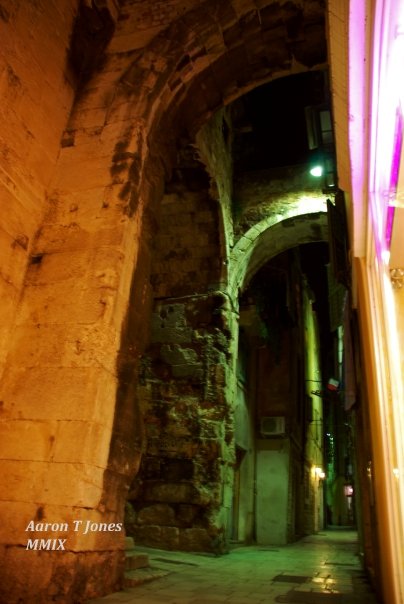
So, we dumped our stuff there and walked into town, which took a grand total of five minutes (which was another great thing about the apartment and the price). We had a look around the centre, and it was old. The walls were still original, but in good condition. The streets and alleyways were narrow, with the same slabs and pacing that were placed there centuries ago. The buildings were old and weary, but still used for bars, restaurants, shops, banks and even accommodation. The buildings are built around the ruins. The original Roman pillars still stand in the bank offices, even though they only reach shoulder height and no longer hold up any roof. There are gate arches over streets, connecting one building to another, yet they serve no real purpose now. Flats and apartments are in the old stone walls, with tiny windows overlooking the narrow walkways and squares. Their occupants’ laundry hangs on small lines over streets and tiny yards and the countless people who walk them. However, despite being this a weekend, the centre was absolutely deserted. In such a place, we expected quite a lot of people in bars and restaurants and walking around in groups making noise and stumbling around drunk. But there was hardly anyone to be seen. It was quiet, which seemed to be very eerie in such a place.

We found this restaurant that Suzi recommended, it was at the far end of the front and apparently it was cheap, but good. There was, however, a lot of cats around, presumably stray ones. But they didn’t just go around this area; they were nearly everywhere, even by the apartment. But these cats were comical; doing normal cat things, like chasing each other, play fighting. We could see them running around on the canopy above us.

I had some shark, as I thought I’d try out the local stuff, especially as it was by the sea. And it was nice, too, especially with this kind of vinegar and pepper. And after a while walking around this ancient settlement and along the front, we heard some voices and laughter. We couldn’t see where they were, until we looked up and on a balcony, there was this bar. So we went to see what it was like.


We climbed these stairs into this narrow, dark bar and sat down. The balcony was even narrower and busy, but eventually found somewhere to sit. And as it happens, there were two Irish guys sitting next to us. They weren’t the same ones in Ljubljana, and they were in a more cheery mood and went on about how great it was to win the Grand Slam. One of them was really drunk, trying to hug his friend and joking about his bald head, even though he was bald himself. But it was funny to watch, especially as he tried to get his drunken friend off him.

But now it was time to go back to the apartment. We caught up with the Irish guys on the way back, one who tried to climb a statue, and the other who hid behind a corner to jump out on his friend, but his plan failed when he mistook us for him. They obviously had quite a lot to drink, so I wonder if they did get up early enough to go to Hvar the next day.

The tunnelled coastline.

Day 4, Part I
Ljubljana, Slovenia – Split, Croatia

As we were leaving Ljubljana, we briefly stopped at Tivoli Gardens. It was basically a park on the way out of the city, with a manor and some trees and a fountain of a boy caressing a fish. The path leading up to the manor was interesting itself. It didn’t provide many views, though. Towards the city, we saw the silhouettes of office and housing blocks, a few cranes against the dull and cloudy sky. Looking up the path were trees and the steps to the manor, which was actually to the right off the path a bit and the manor itself partially obscured by the trees.

But along the path were large photographs. On one side, there were colour photographs of Ljubljana and its streets and landmarks. On the other side, there were black and white photographs of Tivoli Gardens and the manor, some were just plain photos of them, yet others were more interesting and abstract, or viewing the manor from different angles.

After wandering about a bit, we had to move on to Croatia. It was all motorway, apart from the last bit. But getting into Croatia proved no problem. We even managed to get a stamp in our passports, but we had to get them at the declaration barrier, as Rob failed to ask the first time round, much to my un-amusement. Though I was happy to know that it was possible in the end. The stamp was good, too. Its border was of a nice pattern, something similar to Celtic decorative patterns, and the name ‘Republika Hrvatska’ written on the top. The next thing to get now was some currency.


At some services near the border, which had a broken down recovery van with ironically flat tyres (even with ‘Pannenhilfe’, in black bold font on the side), we stopped to get some money out, which for me, proved difficult. Rob got three hundred Kuna out, and as I went to get some money, it didn’t. After the ordeal with the windscreen in Basel, I was worried that I had no money left, even though I was sure there was some left. I tried all of my cards, but to no avail. I was hoping it was just the machine that simply ran out of cash and not my accounts.

Rob also checked up on his friend, Raj. The situation was, he and the uni lacrosse team were off to Salou for holiday. They got as far as Coventry on the coach, when Raj got drunk and spewed up after downing a bottle of wine and whatever else. Apparently, as Raj isn’t a heavy drinker, they took him to the nearest hospital and just left him there, but without his case and stuff. They were bound for Spain. And so he woke up in hospital, dressed in someone else’s clothes, or clothes that the hospital provided from the ‘Lost and Found’ bin, or any other random bin by hearing the description of them.

We first heard about this when he phoned Rob when we were in Ljubljana to ask him about trains to Birmingham, where his unaware parents live and were soon to find out that their son failed to make it past the Port of Dover. Rob suggested going to one of the train stations in London by the Underground, and then taking the train home, but that could only happen if the Underground trains were still running at that time. The other options were to stay at Rob’s, or just stay in a station overnight until the first train in the morning arrives. And Raj did not get his £500 back for the trip and apparently, he got hospitalised before as a result of alcohol and the lacrosse team. And soon enough, the story spread amongst others.

Back in Croatia, we were driving south along the motorway, and what struck us about it was, it was quiet. There were not many drivers at all on the motorways. We weren’t sure whether it was because of the tolls, which weren’t that high. Not compared to standards we were used to anyway. It may have been because Croatia isn’t the most developed country, and maybe people don’t have the cars that are good enough for the motorway. Maybe they didn’t like using the motorways, and preferred the more scenic and rural roads.

Croatia had a lot of tunnels, too, which Dai missed out on. Not the longest of tunnels, though, but altogether, there was a lot of darkness. After spending some couple of kilometres in a dark, smoky, dingy tunnel, I had to prepare my eyes for the bright impact of the sunlight at the end of the tunnel. At first, it was difficult, but I got used to it after about a dozen tunnels. Here are a couple of photos
that I took in Pakoštane (doubtfully pronounced the same as Pakistan):


After leaving the motorway, we went onto the 8. The 8 is a number designated road that runs along the Croatian coastline, passing the thousands of islands sprouting up from the surface of the Adriatic. We exited a tunnel, and the view was something I haven’t seen before. The road winded downwards towards the coast. The ground was dry and rocky with some shrubs and small trees. The coast was jagged rock and the sea was clear. There was some kind of lake, similar to a large rock pool, only separated by the sea by a thin, rocky wall, only leaving a small pass connecting the waters of the sea and the lake. The sun was getting lower over the sea, turning the sky into a golden colour with a hint of dark red and setting a bright, yet magnificent reflection on the surface of the sea. The scene was familiar along the coast. The islands being ghostly silhouetted against the sun and the haze and the glistening sea becoming a golden colour.

Thursday, 30 April 2009

It's raining, it's pouring, the old man is snoring.


Day 3, Part II
Bled, Slovenia – Ljubljana, Slovenia

We got going again after a local beer and a few photos around the lake. The motorway was quiet and the landscape was becoming less frequent of any mountain or hill. The weather thought it would give itself a change, and for the first time in a while, it began to rain. We hoped that this wouldn’t last the whole two weeks that we were away, as it would just be the worst timing. But this downpour didn’t matter to us in any way, due to the fact that we were in the car and thankfully it soon ended.

Finally, Ljubljana was in sight, and it was now just a matter of finding somewhere, preferably convenient and cheap, or free, to park the car. The hostel was right in the centre on the riverbank. It was awkward, because even though Ljubljana is a small city, it’s also an old one, and the streets were sprawled everywhere, many were in pedestrian zones, in one-way systems or obstructed by road works. But first, we had to cross the river.

Thankfully, it wasn’t so bad finding a parking spot. We managed to find one next to the river. As I had to get the car through automatic bollards, we thought there would be a charge for it, but there was no sign of any signs to tell us. And we were only going to be there until the next morning.

The hostel didn’t prove the easiest to find, either. We knew it was beside the river, but no idea how it looked. We had to count the number of the buildings down, only to realise it was just the street up from where we parked. We counted down as we lugged our cases and bags with us, making some noise as the wheels ramped over the countless cobbles. We had to pass through areas full of tables and chairs and people at cafés and bars that ran the length of the river until we got to the hostel. Tucked away in the corner of a building, out of view from our direction and right next to a trendy looking bar.

Through the large wooden door, all there was to be seen was a desk, a few laundry baskets and a few steps leading up to glass doors. It was quite dark and quaint, and after checking in, we made our way upstairs when we found where they were. The room was of a decent size. It had seven beds: three bunk beds and a single. Three of them were occupied; two English guys were sorting their stuff out and another guy (who we later learnt was a guy from Oregon called Sheldon) was sleeping but snoring as loud as something old and mechanical. We hoped that he would be out and about for the night, going by the assumption that he wouldn’t be tired after sleeping the whole day.

We headed out to the city after dumping our stuff in the room, and wandered about to see what the place had to offer. Rob had been here before and suggested to take the funicular up to the castle that stood upon the hill. On the way there, Rob went to a cash point to get some money out, while I noticed a bare footed tramp sitting and writing away nearby. His beard was long and bushy and possibly had signs of primitive, single celled life thriving in there somewhere. If not, I’m sure microbiologists would also have a field day under his toenails.


And from the top of the hill, we stood on one of the castle walls, which looked over the city. The development of the area was easy to see. In the centre, all you could see were red tiled roofs of the old houses and buildings, now mostly serving as restaurants, hotels, shops and banks. Then on the suburbs, we saw dilapidated and aged blocks of flats. They were of the typical Soviet architecture: grey and dull concrete, dirty single pane windows, satellite dishes popping out of the balconies and the shape of the buildings were square. They were just horrid blocks of concrete and ugliness. Further afield and beyond the mass of huge Lego bricks, the landscape was flat, apart from the mountains in the far distance, and could just about be worked out in the haze.

We didn’t really stay long up there. The tower was closed off due to restoration works and there were admission fees for museums and such, and after a walk around the outside of the castle we headed back to the funicular, which seemed to have stopped half way up for some reason. And when it eventually arrived to the top, me and Rob, the only passengers so far, boarded it, only to be told to get off again and wait five minutes.

We didn’t really understand what the staff member meant, but we got off anyway, and saw him take it down to the bottom, only to pick up some passengers waiting at the bottom. So it seemed doubtful that there was any kind of mechanical or technical problem. He then made his way up again, they all disembarked, and we got back on and things were back to normal once more. And the point of that was…? Answers on a postcard, please!

We continued to wander about the centre, passing a market square, cluttered with rubbish, discarded fruit and veg, and council workers with those old-school bristly brooms sweeping endlessly. Later on at the Three Bridges, there was an old lady selling flowers to passers-by. Not your average pensioner, this one was a bit crazy, preaching something in Slovenian to everyone and shoving bouquets in people’s faces, expecting them to buy it.

A couple of days ago, a friend of ours, Oliver, visited Ljubljana when on his trip, and suggested this pizzeria, which happened to be opposite our hostel. I ordered a large pizza with plenty of meat on top, expecting it to be the size of a normal large pizza. However, this was a different type of large. I’m not sure on the measurements of it, but it was about the size as a family pizza. And this place also did family sized pizzas. It took a while to finish it, and both the pizza and the evening were getting cold by the end! But for what we got at a low price and the rapid beer service, it was up there on my ‘favourite pizzerias list’.

We ended up at an outside bar on a square next to the river. As it was cold, for me anyway, we sat next to those heater type things with the flame inside it, even though it was contained in some thin, tall glass tube. The sofa type seats we were on were so low and too far apart from the table and each other, so we moved onto another table with normal chairs that were possible to move. And in our previous spots, three girls sat there. They spoke English and sounded Irish, however, it turned out that two were Canadian and one was actually Mancunian who was part Bosnian. They were all working in Sarajevo to identify the missing and dead of the recent war.

They also recommended taking the route via Mostar and the valley, as the landscape and scenery were spectacular and the town was very beautiful and famous for its bridge. To be honest, that was our planned route anyway, but it’s good to know it was going to be a good route!

We headed our way back to the hostel later, and I could have done with an early night in order for a long drive the next day to Southern Croatia. I thought I’d check some e-mails, too. I was expecting a couple due to problems with my landlady of the house last year at uni, and also update people on how things were going. But that wasn’t possible. My laptop couldn’t access the Internet and the computers at the hostel may just as well be decoration. I think a carrier pigeon would have been more useful. But it was nice to see good ol’ Microsoft 98 again after so many years!

The two English guys in our room were playing cards in the ‘computer room’, and were off to Bled the next day to go hiking. They told us of their own travels, they were, and presumably still are, on a hiking trip around the Mediterranean. Most people would only do the European half, but they were doing it on a much epic scale. Not only Southern Europe and the Balkans, but also they were planning to travel through Israel and into North Africa and along the coast over to Gibraltar and Spain. They were estimating three months it would take, but unsure on the financial side of things. Though I wonder where they are now. But nevertheless, an idea for a future trip!

Time called for us to go to bed, still hoping for the absence of whatever noise that American was making. However, half way through the night, I was awoken not by pneumatic drill-like noises going off by the side of me, but arguing. At first, I thought it was a random who was having a go at one of the English guys about nicking a pillow, and as I tried to hide mine under the blanket and pretend to sleep, I listened in. In reality, it was not someone being peeved off about his pillow going missing, there were two Irish guys going on about who should have which bed. The only ones available was a single bed by the window at the far end of the room, or the bed above Sheldon the Oregonian Snoring Champion. They even argued and cursed each other (a lot) about one owing the other nine Euros and whose turn it was to have a single bed. It got so close to getting out of hand; they almost broke out into a fight. But they were yet to experience the wonders of a restless night as Sheldon soon got back. And with even being woken by one of the Irish guys in hope he’d stop, he carried on almost immediately.

If the nights were to be like this the whole time in each hostel, it would be quite a problem for me, who’d have to drive throughout the whole route. Being an optimist, I still held onto the thought of nice and peaceful and quiet nights
!