Tuesday, 26 April 2011
Ramblings...
Sunday, 27 February 2011
Photo album.
Thursday, 13 January 2011
A Quick Clean Up.
Thursday, 19 August 2010
Hungry Romans.
aah... I'm getting annoyed at myself now. I'm not keeping up with this blog at all. But anyway, what happened after Belgrade? We went on to Budapest, via Romania (we had to clean the car due to the laws against dirty cars), and into Hungary!
Budapest wasn't so bad to go around. Our hostel was just outside the city, but we had to find the tram. And the stops were difficult, because we knew no word of Hungarian. It was also difficult to explain why we didn't have any tickets for the underground. We had no coins. There was no official around for us to buy tickets from, and so we lost 20 Euros (or the equivalent) each! But anyway, Budapest is a great city. Big, though... or maybe we just thought that from all the walking throughout the day! haha! Anyway... another interesting thing happened.
Outside the Parliament building, there is a big square (complete with the usual group of demonstrators), and at the edge of this square, there are three wooden crosses. They were separated from the square by a low chain fence thing. But anyway, no matter how careful I was trying to be not to trip over this chain, I tripped over! And to break my fall, I went to lean on one of these crosses and tilting it over. Luckily, it didn't fall and it was light enough to put back right again!
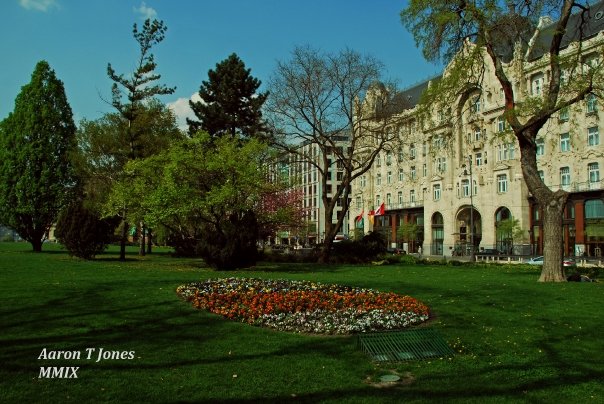
hm... what else happened? Nothing special, I guess. We just went all over the place! The next day, we went to Lake Balaton on the way to Bratislava. It is such an amazing lake. Massive, too! erm... I can't think of what to sat about it, really... but here are some photos, from Romania, Budapest and Balaton, and one out towards Bratislava. There is about 20 of them...


Wednesday, 28 July 2010
Belgrade and the Centar.
But anyway... Belgrade. That’s where I left off!
So, two nights in Hostel Centar, situated on a busy main road going into the city centre. And the room? Well, it was a dorm (with internet access!) on the third floor of an old-looking building. We got there before everyone else arrived, and found these two beds (basically, they were only the mattresses) shoved on this balcony thing above the room, accessible by a ladder. It was a cosy place to stay; it was above the windows and in the ceiling area, where it was sloped due to the roof being there. During the night was warm, though... it was probably the position of the mattress beds, and when the morning came with the Sun beating down on the roof, it was surely becoming an oven!

But anyway, we weren’t going to stay there all day. We got a city to see. And getting there by foot wasn’t too bad. It took a good few minutes, but it was easy enough. We got to the Sava River, just before it joins the mighty Danube, and there, berthed on the banks, were the most rustic and poor conditioned boats I have ever seen. To be honest, I don’t know what they were. They were boats, but didn’t look as if they were. They were more like old buildings or abandoned warehouses that floated alongside the riverbank.

We made our way towards the fortress on top of the hill. The fortress, Kalemegdan, whose site has been occupied over thousands of years, stood on the hill overlooking the confluence of the two rivers running through Belgrade and overlooking to two main areas of the city, New Belgrade on the opposite side of the River Sava, where the banks and high-rise offices are based, and Old Belgrade, where the cultural and historical parts of the city lay.
The fortress was in between these areas, so all walks of life could be found passing through the fortress and the park within its walls. There are people sunbathing on the lower walls of the fortress, old men playing chess in the shade of the trees and kids asking people like us for a couple of Serbian Dinars to buy some ice cream and people on stalls selling Serbian stuff and Serbian fruit wine, which I still have a bottle of!

After a few hours wondering around the city centre, passing old concrete buildings with signs in Cyrillic, and old car with a Christmas greeting on the bonnet and lots of battered and rusty trolleybuses, we headed back to the hostel to change and ask the guy at reception about somewhere to eat. He suggested the ‘Mark of Question’. We were a bit confused about this, but when we got there, this place actually had no real name, but the place was actually called ?. But it looked nice enough... it was busy, too. The menu was also interesting. After asking the waiter what this dish was, he said it was basically bull testicles. Unfortunately, it wasn’t available that night, so I settled for simple goulash. Still good, though! But I couldn’t tell anybody that my food was a load of bollocks...
But soon after the food and a couple of glasses of local beer, we headed back. It was going to be a long day to Budapest the next day.


Tuesday, 22 June 2010
Remember, remember... what happened on that day again?
June 2009? Pfft... it’s been a while, and where has the time gone? Well, if there are any readers anymore, I would like to apologise to you. Just been a bit busy in the past year and that was mostly uni. But now that’s finally over and done with, I can get back onto updating this dusty, forgotten crevice of the web!
But, before I go on to what I am up to these days, I thought I’d enlighten the uneducated on how the trip around Eastern Europe went, and I shall try to remember the events that unfolded! I think a consultation with last year’s humble diary is in order... and I’ll put on some Beethoven to get in the writing mood!
Let’s see... the last time I posted was about entering Serbia and making our way to Belgrade. It was Day 7 (still), and after the bureaucratic bother at the border, we could finally make good progress to the capital city of Serbia and also what used to be Yugoslavia.
The countryside of western Serbia was very much like that in Srpska: mountainous, sparsely populated and bad roads, though very much picturesque, and naturally I stopped a few times to take a few photographs.

And has anyone heard of a hitchhiker who doesn’t want to get picked up? Well, we found one about ten miles outside Belgrade. For a couple of miles, there was a car behind us, despite it being clapped out, rusty and just plain old, it was being driven a bit erratically and sometimes got a bit too close for comfort behind us. Anyway, as I was coming up to a garage on the opposite side of this wide road, I thought I’d call in for a bit. I pulled over onto the side of the road to wait for traffic to clear and suddenly, the frantic driver behind me skidded to a halt in front of me. The words ‘hijack’ and ‘Serbian Mafia’ came to mind. A passenger got out, walked towards my car and stopped. He just stood there as if he were waiting for something. Anyway, the old car drove off and I crossed the road to park in the garage opposite.
Soon we realised that he was waiting for a lift, and after some consideration, we decided to ask him where he was going and whether he wanted a lift into Belgrade. With his poor English, he went “no, thanks you. No speak English, I want Serbia speak.”
Fair enough, then. I think it’s one of few hitchhikers who had ever refused a lift, though I can understand the reasons being the language barrier. And maybe he wanted to take in the dusty, roadside environment for a bit longer.
And so, finally we arrived in the Serbian capital after a somewhat interesting drive, with crazy truck drivers who thought it normal and safe to overtake slower (or so they underestimated) vehicles, which were often in a similar or better physical condition, when going around bends, and in the countryside of Serbia, there are many narrow and bendy roads traversing along the sides of the winding valleys.
Hostel Centar will be the new home for the next two nights...
Tuesday, 2 June 2009
A Day At The Office
Višegrad, Bosnia and Herzegovina – Priboj, Serbia
Višegrad seemed like a typical post-Communist town. It was in the middle of nowhere, basically. Its river had a hydroelectric dam upstream and the buildings were decaying and architecturally bland with a hint of greyness and concrete. The cars and vehicles were old and dirty, spewing out black fumes from rusty exhausts.
We looked for somewhere that would know about the price of a Green Card into Serbia, and asked in a bank, which was a small room with a metallic desk and bullet-proof glass, who wrote something down in a piece of paper and told us to go there. Presumably it was some kind of office, such as an insurance company. However, we couldn’t really find it, even though the directions were simple: follow the street to the end until we reach a square.

But no, he didn’t. Instead, we went to this office, but as it was empty, we went across the square into this pub, where the guy who ran the office was there drinking and smoking as if it was his day off. Back in the office, there were a few certificates on the wall, a computer on a desk and on the small table in the corner; there were empty whisky glasses and a few cigarette butts in the ashtray. Typical of Eastern Europe. He then took out a cigarette, slowly lit it and began explaining where to go by pointing at the map and how much it was going to cost for a Green Card. His English was very limited and was unable to string a sentence together, and he decided to shout across the square to someone else in the pub.
This second guy began staggering across the road and into the office. It turns out that he spoke German and could tell us more easily about it by the first guy talking in Serbian (or Bosnian or whatever) to the second guy, who then told us in German. It was really confusing, as we tried to ask about things, then going through him to the other guy and then back to us. Eventually, we got things sorted. We had to go off the main road, which wasn’t very main, and then go onto a small country road that took us south through the hills and countryside to a place called Uvaz (or Увац, pronounced ‘oo-vats’). It is a small place, and there it should be cheaper, roughly around twenty Euros worth.
After saying goodbye to the two drunken guys at the office/pub, we headed back to the car and left what was a very amusing and unforgettable encounter. And that’s what I like about travelling amongst other things; meeting random people in random places and trying to communicate with each other through very different languages, and also gaining a much better and detailed map of Serbia and Bosnia & Herzegovina.
Leaving the country to get into Serbia, however, proved another difficult task to get through. We got to the border control, which was in this small village in the middle of nowhere. I parked outside the controls, which were just two small portable cabins with plastic deckchairs outside, occupied by border guards who were either smoking, reading newspapers or playing cards.
I went to ask one of them where I could get money from a bank to pay for the Green Card. He said it would cost about a hundred Euros, not twenty. He said that there isn’t anywhere that would make it cheaper, and the only bank in the area was the one in the village, which closes for the afternoon. To get to an open bank, we would have to drive all the way back into Višegrad, which wasn’t really worth the effort. He also said there was a bank in a town over the border, but it would take about ten minutes by car or two hours by foot.
After confirming this with the Serbian border control over the bridge, I decided we would have to get the Green Card there, but we had to leave the car between the borders until we could get the right documents. And so, we left Bosnia, got an exit stamp on the passports, which looked just like the entry stamp but in blue. The stamps were quite boring, anyway. We expected some kind of different design or layout than the others, but they were very similar to the EU stamps, but with the letters in Cyrillic.
We left the car just before the gates into Serbia, and went to talk to the guard there. She said she would have to phone the insurance woman, who would have to drive to the border, pick us up, then take us into Priboj, which was a five minute drive, then take money out of the bank, then drive back to the border and sort the Green Card out and then be on our way. But the cost was going to be a hundred Euros, plus some money for the woman who was to take us. I had that feeling it was going to be fun!
We waited for the woman to arrive and sat in the car until she did so, and as we waited, we listened to some of the Ricky Gervais Show and played Monopoly on Rob’s phone for at least an hour. We tried to figure out what car she’d drive and whether it would stop at the car park on the other side of the barriers. We wondered what type of car, too. In Bosnia, the cars were old, rusty, cheap, incomplete, damaged, smoky and were just unfit for proper roads. We doubted that the nicer and better cars would be a popular sight, and if they were around, they were probably driven by government officials, banker managers, successful businessmen and some people who make their money in dubious ways.
And then she arrived. We didn’t see what she drove, but we saw this blonde woman walking towards the barriers, crossing the street and out of view. We had no idea why she did this because all that was on that side of the road was wasteland and some railway and the border offices were on the other side of the road. Then the guards called us over.
They explained that we had to go in her car, go to Priboj, get the money, come back to the border and pay for the Green Card, then go. So nothing we didn’t know already. And then off we went. Her car was a white Volkswagen Golf, of the second mark. It had all the tell tale signs that it was being driven in a developing country. Rust, stiff door handles, unclean inside and out, with tapes strewn everywhere as well as tissues, old crisp packets and other wrapping, empty beer cans (I just hoped that they’d been there at least since the day before). The seats were really dusty and not in their original black colour. The tape deck was missing a tape player, and the rev gauge behind the steering wheel was missing the needle and half of itself. I couldn’t tell if the speedometer was working properly, though. And so we just sat in the car for about ten minutes to Priboj, and making a conversation was a lost cause, with us unable to speak Serbian and her not speaking English nor German. It felt kind of awkward.
On the way to Priboj, we passed what seemed more primitive than Višegrad. The first thing that caught my eye was this huge plain and ugly building on the side of the road. It looked very similar to all the other large buildings we have come across so far. I assumed it was a disused power station or something. The windows were either boarded up or smashed and the walls were cracked and dirty. There was no sign of life at the place, apart from weeds and plants sprouting out of the concrete.
There was nothing much spectacular in Priboj, either. It seemed busy, but what was there, I don’t know. We didn’t really go far into the place, as we headed straight back after getting the wad of worthless notes out. And after signing the forms and relevant documents for the Green Card, we got out passport stamped (which looked just like the Bosnian, but smaller), we finally were on our way into Serbia, again.
Добродошли у Републку Српску
Sarajevo, Bosnia and Herzegovina – Višegrad, Bosnia and Herzegovina
As we got to Sarajevo rather late, we thought we’d have a quick look around the place before setting off to Serbia. The city is rather small, and could easily be seen in an hour or so. The smell of cooking ćevapi was still in the air and the crowds of people were larger, and so were the groups of pigeons.
I was half tempted to buy a fez, as they were on sale in the many shops that surrounded the square along with the cafés. In the end I didn’t, but I did see a fez on the head of this old man sitting in front of the gates of a mosque as he was smoking a rolled cigarette and possibly preaching his wise words to the passing public.
Back at the hotel, we tried to find out about Serbia, the Green Card and the tolls for the motorways there. The receptionist didn’t know, but a Polish guy, dressed rather smartly in a suit, recognised our accents and asked if it was our car outside with the Welsh sticker on the back. Indeed it was mine, and he went on about when he lived in Porthcawl for some time and we were all talking about Swansea, Trecco Bay and other random stuff about home.
We also asked him about the tolls of the motorway in Serbia. We heard that it would cost us an equivalent of 85 Euros, to which he replied was crap… of the bull kind. He said it was much cheaper, but not sure by how much, though it certainly didn’t add up to such an amount. Though he agreed that the Green Card for Serbia was significantly worse for the wallet, in places it can add up to around a hundred Euros, but in some places, especially the more isolated and smaller border stations, it can be for much less. He also told us of someone he knew had an ‘under the table’ deal with the border guards, which cost him just twenty Euros. So even the border guards think it’s a rip-off.
And so off we went and out of Sarajevo. Leaving the noise and smells and bustle of a city and entering valleys of farmland and forests with bad roads. Later on, we passed a couple of police officers or soldiers with small automatic rifles. We weren’t sure what they were there for or why they were armed like that until we went under a small tunnel and around the corner saw a large sign, both in Roman and Cyrillic alphabets, welcoming us to the Srpska Republika.
From this point onwards, things began to change in this Serb region. The roads became worse, the road signs were all in Cyrillic and the fuel prices were all the same in every garage. It really did feel as if we were in Eastern Europe, luckily, I could read what the signs, otherwise we may well have been stuck. But the landscape was still scarce of human life. There were few houses, and the villages we passed were more like hamlets and there wasn’t much traffic on the roads apart from the few small tractor like carts struggling the ascent of the many steep roads.
As we got closer to the border, we weren’t sure where the best place to go was. We didn’t have any decent maps of the area, as the government may be a bit sceptical about allowing images and mapping being loaded on the Internet. So we stopped in this seemingly isolated town called Višegrad.
Tuesday, 12 May 2009
A crash course in bridge diving and raki.


The river cuts through the mountains, forming a steep valley, flanked by dense, green forests. Both the road and the railway run along the steep mountainside, through many tunnels and over several bridges, sometimes we were driving on a platform, built hanging over the riverbanks. All that we saw were high mountains, forests, the blue river and old, aged hydroelectric dams and power stations. However, as the river and valley was not very straight at all, neither were the roads, making it difficult to get passed some of the many lorries and slow vehicles that frequent this route.

Finding the hostel wasn’t too straightforward, either. Quite literally. We had to run alongside the river, bypassing the centre of town until we got to a junction of some kind. It was unclear what this junction looked like, as it was right at the edge of the map. But we could work out that it bent left, nearly double backing on itself. And we believed we came to such a junction, as it seemed there was no way to continue apart from trams. So we went left, following the road around, straight into the centre of town itself.
Road and safety awareness goes straight out of the window at this point. There are crowds of people congregating in the middle of this junction, as trams, taxis and cars try to make their way through. And the way we needed was right in the middle of it. I had to get the car through this crowd and up the hill, but slowly I made it. Then we took a couple of back streets (which were just normal Sarajevan streets, apparently). We got to a small fork junction, one straight ahead, but blocked by a parked car, and one up a steep hill with a no entry sign. So I had to choice but to make it up that hill, after all, it was short and everyone does what they well like, anyway!
Finally at the top, after abusing my clutch and creating that lovely burnt smell that it does, we went further along the maze until we reached the hostel. It looked like a hotel, in fact. It was one of those places that could be described as both. And blending in with other residents of Sarajevo, I parked wherever I could, which happened to be right in front of the hotel, but conveniently making enough room for anyone to pass, if they were able to actually make further progress.


We found this outside bar showing some football match between some two teams, but all I was interested in was the beer. Later on, we started talking to this group of Americans, who were serving in the army in Germany. We moved on from talking about football, or soccer, and went on to talk about Sarajevo, Bosnia and the situation it was in just less than two decades ago.
We parted ways and later we found a bar, which had a more Turkish oriented feel to it. We had some more kebab type stuff there, and Rob suggested we got a raki, which was a herb based spirit drink, like tequila or grappa, but much to my distaste. Not only was it strong, but also I just couldn’t get round the taste of it. So Rob finished it off for me. In the meantime, we were talking to the barman about where he was from (Turkey), where Rob went to in Turkey, and also more conversation about how the country is developing after independence and war and all the troubles in the past years.
And after a long time conversing about these things, it was time to get going. But getting into the hostel was not just a matter of walking through the door. It was locked, and the button to ring the bell didn’t seem to work. The lights were off and there was nobody to be seen. Though there was no sign of any closing times, if hostels actually have closing times. We spent some time outside, walking around the buildings trying to find a way in, but to no avail. There was the option to stay in the car overnight, even though it wouldn’t be as comfortable. However, we eventually caught a reflection of light in the window, and the receptionist was at the computer of the front desk. Thankfully, we could easily get her attention and she came to the rescue!
The Green Card for a hot day.
Split, Croatia – Mostar, Bosnia and Herzegovina
It was time to leave Split and the apartment and head in a more Easterly direction towards the unknown. We didn’t really know what Bosnia would be like, apart from what the girls told us in Ljubljana. We couldn’t get anything from Google Maps about Sarajevo, but a grey area with a road running through it. There was also no information about the landscape, either. But we thought we’d go for it, anyway.
After filling the car, we got some stuff from the shop at the bottom of the road. The car, however, needed a good cleaning. It’s a red car, but today it was yellow. The amount of dust and dirt flung up from the roads just covered my car along the journey. But the roads will only get worse, I thought, so was there much point in cleaning it now only for it to get dirty again?
Finding a way out of Split was much easier than finding a way in. It was daytime now meaning I could see better and I wasn’t as tired, either. There was a short motorway heading to the border, so we thought we’d use that, especially as the toll would take up all of our remaining currencies. However, finding that wasn’t to be. For some reason, the signs for it disappeared, something we were well used to by now. We continued along the coastal road until it took us into Bosnia, which was equally picturesque as the parts on the other side of Split. We drove along through seaside villages, all with creamy white walls, small windows and red tiled roofs, and with Hvar by our side, a long island running parallel to the coastline.
We finally turned inland and away from the coast and towards the border of Bosnia and Herzegovina. We came to the last Croatian town, wondering when the border would pop up, and then we saw it. Two booths, the first with the red, white and blue shielded flag of Croatia, and the other with white stars running diagonally down the yellow triangle on a blue background. To me, the Bosnian flag had something reassuring and modern, and something telling me that the country was welcoming, even though it was still scarred by the war that tore it apart not so long ago.
At the border, however, there was just the one hitch. The Green Card. They asked for it, but I didn’t have it, unaware that I could get one for here. I’ve heard that some insurance companies don’t even hand them out for certain parts of the world. I had that terrible feeling that this could be the end, or at least as far as driving was concerned, but that was not an option. I would rather turn back and go home instead of ditching my car in No Man’s Land between two Balkan countries.
The images of Mostar, Sarajevo and possibly a lot more started to fade as I tried to think what to do. Luckily, I found out I could get a Green Card for the equivalent of twenty Euros at the border, but I didn’t have anything adding up to that much on me, and annoyingly, there was no cash point machine at the border. And so back into Croatia it was.
The town we just drove through a few minutes before happened to be big enough to have a shopping centre and a couple of banks, providing us with enough money to get the Green Card that would allow the car across the border.
And finally into the Herzegovinian part of the country, we drive along dusty, bad surfaced roads, passing farmland and old buildings, either shelled during the war or abandoned as the occupants left the area, either fled during the war or left to find better work in better places. The buildings that were still occupied were not in much better condition, either.
The architecture didn’t seem much different from Croatia, but they were much worn down here. The plaster and brickwork were crumbling apart, plants and weeds were growing in the cracks of the walls and through window frames. However, for me, I saw my first traditional mosque, complete with a dome and a minaret, with its masonry decorated with arches and carvings in the stone.
The landscape of this new country was magnificent. Nothing seemed spoiled by large, ugly, high-rise towers. The farmland was of haystacks supported by large wooden poles; farmers drove their tiny tractor carts along the side of the road; cattle grazed in the green fields that ran over to the foot the whole way to the mountains. However, because of the war, the countryside was, and still is, littered with landmines, most of which are still active and pose a lethal threat for those who wish to hike around the peaceful, picturesque and unspoilt landscape.
But we drove on, passing a garage, with its thermometer reading twenty-nine degrees Celsius, and following the vandalised road signs towards Mostar, a city famous for its bridge and what happened to it during the war. Stari Most, or Old Bridge in English, may have given the name to the town, or as most means bridge, and there are a few of them spanning the river that runs through Mostar, could be the origin of the city’s name instead. To be honest, I'm not entirely sure, but they are my theories, anyway!